Available MONTH DAY, 2026
Command the Room
Before You Fix Your Voice
From Coping Mechanism to Claimed Authority
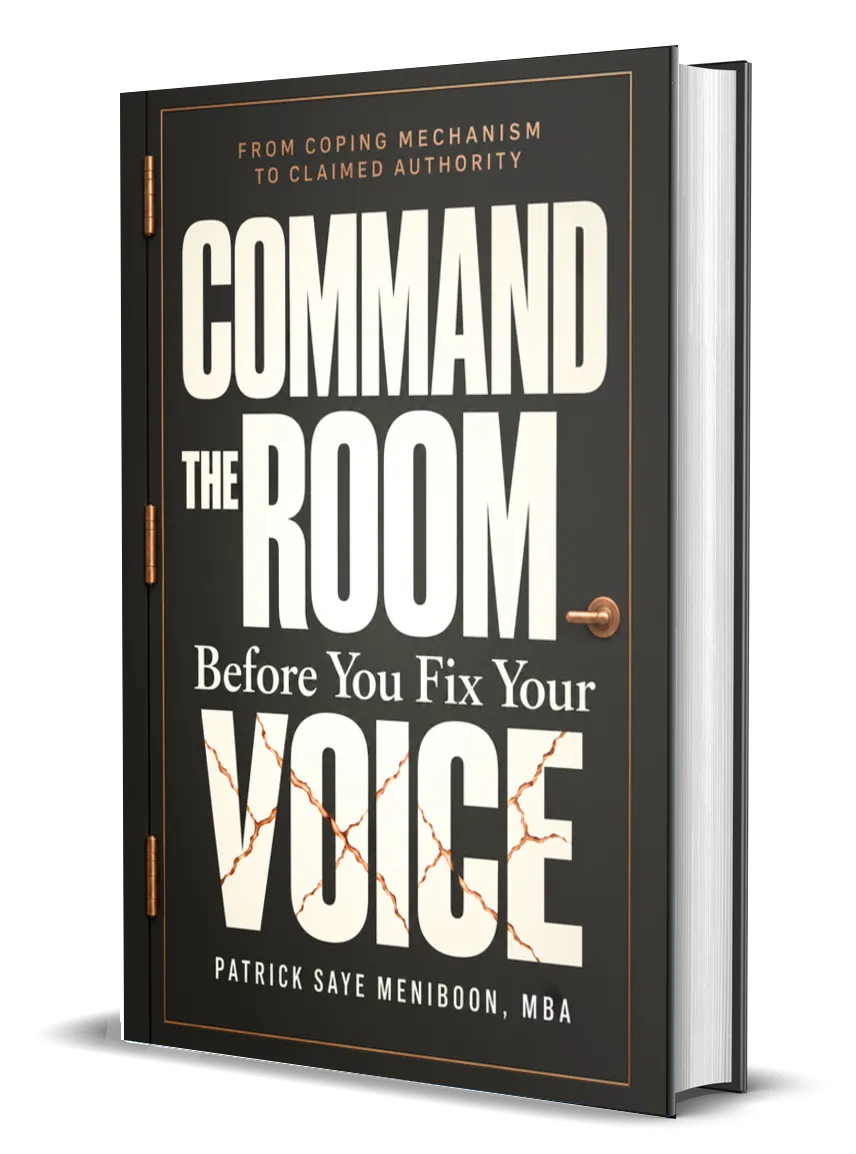
Most people spend years trying to become someone worthy of commanding the room while overlooking everything in their life that has already prepared them to do it.
The thing you wish were different about yourself may have shaped your life. But it does not get to define your authority.
A stutter. An accent. A rejection. A loss. A diagnosis. A mistake.
Over time, what happened can become the story you tell yourself about who you are, what you’re capable of, and whether you belong in the room.
In Command the Room Before You Fix Your Voice, Patrick Saye Meniboon shares his journey from growing up with a stutter in Liberia and enduring separation, war, loss, and fear to realizing that the years he spent surviving had developed strengths he had never learned to recognize.
Through personal stories and practical reflection, Patrick challenges readers to stop seeing themselves only through the wound and start recognizing what the scar proves they survived.
Inside, you’ll discover:
✔ How painful experiences and labels can quietly become part of your identity
✔ Why separating what happened from what you concluded about yourself can transform your story
✔ How years of adapting and surviving may have built strengths you’ve overlooked
✔ Why confidence does not have to come before action or leadership
✔ How to stop waiting until you feel “fixed” before speaking up and taking your place
✔ How to recognize the authority your life has already given you
Written with honesty and hard-earned perspective, this book is for anyone who has ever wondered whether they were confident, polished, qualified, or ready enough to be heard.
Whether your “voice” is something others can hear or something you have spent years holding back, Patrick invites you to ask a different question:
What did living through it require you to build?
You may not need to become someone new before you command the room.
You may simply need to claim what your life has already built.
Does this sound familiar?
You know you have something valuable to contribute, but part of you still hesitates when it’s time to speak up, step forward, or be fully seen. You may be capable, experienced, and prepared, yet still find yourself second-guessing how you’ll come across, rehearsing what you want to say, or wondering whether you truly belong in the room.
You’ve spent so long focusing on the thing that feels wrong, different, or unfinished that you may have overlooked everything you built while learning to live with it. A stutter, an accent, a rejection, a failure, a loss, or another painful part of your story may have become the lens through which you explain yourself, even when your life contains far more evidence of strength, adaptability, courage, and authority.
You’re tired of waiting to feel completely confident, polished, or “fixed” before allowing yourself to take up space. You want to stop letting one part of your story decide how visible you can be, how boldly you can lead, or whether your voice deserves to be heard, and start recognizing the authority you may already have.
If any of this sounds like you, join the waitlist.
Meet the author
Patrick Meniboon
Patrick Saye Meniboon is a Human Calibration strategist, speaker, author, and AI strategy advisor. He is also the creator and host of Dialed In with Patrick Meniboon, a podcast and YouTube channel examining confidence, courage, self-belief, leadership, engagement, AI adoption, and human performance through the lens of Human Calibration.
Born in Liberia and living with a lifelong stutter, Patrick was a two-time valedictorian. He skipped the valedictory speech that came with his first honor in junior high and tried to again skip the second in high school before finally taking the stage. Years later, with the stutter still present, he reached the finals of the 2015 Toastmasters District 6 International Speech Contest, one contest win from joining the ninety-six district winners who advanced from more than thirty thousand contestants worldwide to the World Championship of Public Speaking semifinals.
The stutter had not disappeared, but its influence over what Patrick believed he could do had changed. What had once seemed like a switch, something that determined whether he could speak, participate, or command a room, began to look more like a dial. As its influence was turned down, other capacities became available: preparation, courage, observation, connection, authority, and the ability to act before feeling fully ready. That contradiction became one of the clues behind Patrick’s fascination with Human Calibration.
His work now begins with one question: What are we miscalibrating here? Patrick studies the load-bearing variables that carry disproportionate influence over how people and organizations respond. His research-informed and evolving Human Calibration method examines a condition or situation through five interconnected doors: Body, Meaning, Behavior, Context, and Compass. The aim is to find the variable beneath the visible problem and identify the smallest credible adjustment that could change the result.
Patrick’s professional work spans complex enterprise operations, process improvement, organizational change, and AI strategy and enablement. He is known for finding the hidden variable beneath visible complexity and turning hidden capacity and emerging possibility into practical value. That same curiosity shapes his belief that, as machines become more capable, humans should remain in the lead.
Patrick lives in Raleigh, North Carolina, and has a thing for belt buckles and cowboy boots.